Spare Rooms, Real Loads: Electrical Safety for UK Businesses Run from Home
The quiet shift in domestic demand
A home is no longer only a place of rest. In 2026, spare bedrooms host beauty treatment couches, garages accommodate 3D printers, kitchens double as catering prep areas, and conservatories become sewing rooms or e-bike charging stations. For many micro-businesses, this is a sensible and cost-effective way to trade. The electrical installation, however, may still be configured for ordinary domestic life: a ring final circuit for general sockets, a radial for a utility area, a lighting circuit, and perhaps a dedicated supply for an oven or shower.
That does not make home-based trading inherently unsafe. It does mean the electrical system deserves a fresh look. Domestic circuits are designed around expected household patterns, not necessarily around continuous motor loads, heat-producing equipment, repeated charging cycles or several devices running at once for hours at a time. When livelihood plugs into a domestic circuit, the duty of care shifts.
How a domestic circuit becomes overloaded
A standard UK ring final circuit is commonly protected at 32A and serves a number of 13A sockets. A radial circuit may be protected at 20A or 16A. Neither figure is an allowance to draw that current from every outlet. The protection is there to safeguard the cable, not to advertise spare capacity.
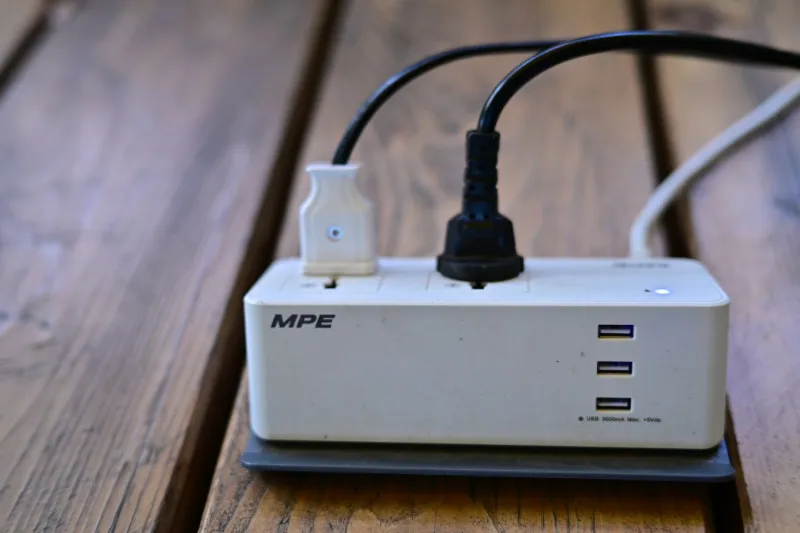
Overload often arrives quietly. A beauty therapist may run a steamer, heated couch, steriliser and lighting from one room. A tattoo studio in a converted garage may use power supplies, lamps, a compressor and a cleaning station. A small sewing business might operate several machines, an overlocker and an iron. A 3D printing setup can draw steady current for many hours, while an e-bike charger adds another sustained load. Individually, each item may seem modest. Combined, and especially through extension leads, they can push a circuit towards its limit.
Diversity is the missing word in many home business conversations. Domestic installations assume that not everything will be used simultaneously. Commercial routines are less predictable. A kitchen-based food business may run fridges, a microwave, a kettle and mixers at the same time. A garage workshop may have a heater on while power tools are in use. The result is not always an immediate trip. Cable and accessories can warm over time, plugs may discolour, and the risk of failure rises before anyone notices.
What insurers and licensing bodies tend to ask
There is no single rulebook for every home business, but common themes appear in insurance questionnaires and local authority licensing. Public liability insurers frequently ask whether portable appliances are tested, whether the fixed installation has been inspected, and whether the business uses equipment that generates heat or runs continuously. Home insurance policies may exclude business stock, equipment or public liability, so a separate policy or extension is often needed.
Businesses offering treatments that require local authority registration, such as tattoo work or certain beauty treatments, may be asked to demonstrate electrical safety as part of wider health and safety conditions. Food businesses may face similar questions during inspections. Landlords and mortgage lenders may also have an interest if a property is being used for trade. The precise requirements depend on the activity, the insurer and the local authority, so checking before equipment is installed is far easier than resolving a query afterwards.
Portable appliance testing, EICR and the paperwork that matters
Portable appliance testing, usually called PAT testing, is a routine check of appliances and their leads. It is not a blanket legal requirement for every item in every setting, but it is widely expected by insurers and is a sensible part of a home business risk assessment. Equipment that is moved, handled by others or used in a public-facing room deserves particular attention.
An Electrical Installation Condition Report, or EICR, assesses the fixed wiring, consumer unit, earthing and protective devices. For domestic properties, an EICR is commonly recommended every five years or on a change of occupancy. Where the property is used for business, the interval may need to be shorter, depending on the equipment and the insurer's view. The important point is that the EICR and PAT testing answer different questions. One covers the installation; the other covers appliances. A home business may need both.
Warning signs not to ignore
A socket that becomes warm in normal use, a plug with brown discolouration, a burning smell, buzzing from a dimmer or a circuit that trips repeatedly are not inconveniences to be managed with a longer extension lead. They are messages. An RCD or RCBO that trips may be responding to a fault, and resetting it without investigation can mask a serious problem.
Other signs are less dramatic: lights that flicker when a machine starts, a fuse in a plug that fails repeatedly, or equipment that only works when other items are switched off. These patterns suggest the load or the circuit is under strain. In a home business, where equipment may be essential to income, a single failed socket can become a single point of failure.
Practical safeguards for home-based trading
Begin with an assessment rather than a guess. A qualified electrician can establish what each circuit serves, measure loads, check protective device ratings and advise whether a dedicated circuit is appropriate for heavy or continuous equipment. High-demand items such as e-bike chargers, large printers, kilns, compressors or multiple treatment devices should not be casually distributed across general sockets.
Keep extension leads temporary. Avoid daisy-chaining adaptors. Site charging batteries away from escape routes and sleeping areas, and never leave heat-producing equipment unattended without a suitable risk assessment. Label business equipment and maintain a simple record of PAT testing and EICR dates. If the business grows, revisit the electrical plan before adding another machine.
Custodian Electrical works with homeowners and property managers who need clear, practical advice rather than alarm. A home business can operate safely on a domestic supply, but only when the installation and the workload are understood together. Safety first, always.