When the Grid Goes Quiet: Safe Standby Power for UK Homes and Commercial Premises
Every winter, usually in the days after the first named storm, our phone lines fill with the same question: can a generator be connected to the house? The honest answer is that it can — but only within arrangements that have been designed, installed and tested. A generator bought in a hurry on a Friday afternoon and plugged into a kitchen socket is not standby power. It is a hazard waiting for a chance to prove itself.
This article sets out what UK homeowners and property managers should understand before the lights go out, and what should be documented before an electrician arrives on site.
Start With the Load, Not the Generator
Generator sizing is routinely approached from the wrong end. The temptation is to buy the largest set the budget allows and assume the problem is solved. In practice, the starting point is a load assessment: what must keep running, for how long, and at what surge.
Refrigeration, heating circulators, pumps and any motor-driven equipment draw a starting current several times their running rating. A modest set may run a boiler and a fridge comfortably yet trip the moment a pump kicks in. Conversely, a large set running at a small fraction of its capacity wastes fuel and can run inefficiently for long periods.
A few practical realities are worth stating plainly. An electric shower, an immersion heater or a heat pump compressor will not be supported by a small portable set. Any plan that quietly assumes otherwise is a plan that will fail at the worst possible moment. Load diversity, prioritisation and, where necessary, deliberate isolation of heavy circuits all belong in the design.
The Carbon Monoxide Risk Is Not Theoretical
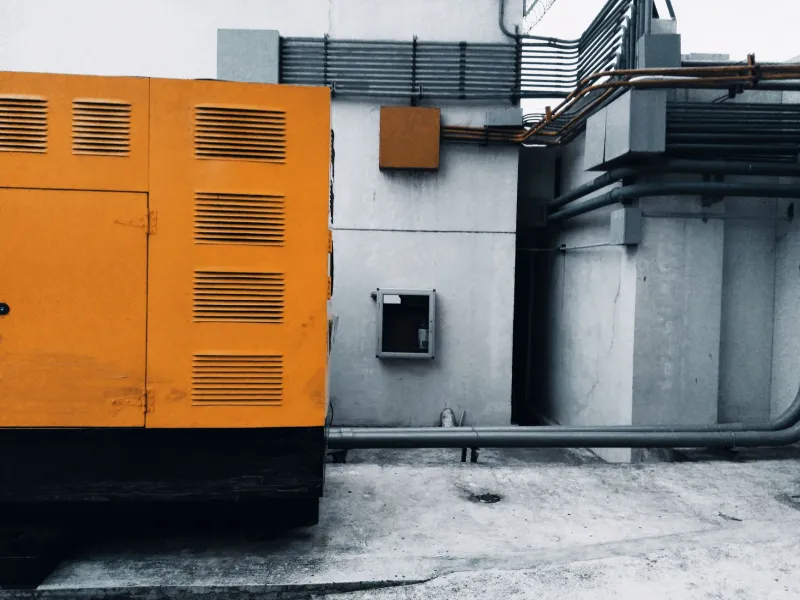
Portable generators produce carbon monoxide in quantities that can be fatal in an enclosed or semi-enclosed space. They must never be operated indoors, in a garage that forms part of the building, in a basement, in a conservatory, or in a shed attached to the property. Nor should they be sited directly beneath a window, adjacent to an air brick, or close to a flue or ventilation intake serving the building.
Two further points are frequently overlooked. First, refuelling a hot generator is a fire risk; the set should be shut down and allowed to cool before the cap is removed. Second, a carbon monoxide alarm within the property is a sensible safeguard but not a substitute for correct siting — it is a backstop, not a licence.
For commercial premises, the same principles apply with additional complexity, since plant rooms, loading bays and service corridors are often poorly ventilated and easy to overlook when a temporary set is wheeled in.
Backfeeding: Why the Double-Ended Lead Is Never Acceptable
There is a persistent myth that a property can be powered by a lead with a plug at each end, one into the generator and one into a domestic socket. This is dangerous and unlawful in effect. It energises the installation in reverse, bypasses the means of isolation, and can place line voltage on conductors that a Distribution Network Operator's staff or a neighbour's property may reasonably assume to be dead. It also offers no protection against the generator and the network being connected simultaneously.
The correct arrangement is a changeover facility — either a manual changeover switch or a properly designed automatic transfer arrangement — that isolates the incoming supply before the generator is connected. The switching must be break-before-make so that the two sources can never be paralleled. Such work is not a DIY task: it involves the intake position, the earthing and bonding arrangement, and in England and Wales is notifiable work under Part P of the Building Regulations when carried out in a dwelling.
Earthing deserves particular attention. Whether the installation is TN-S, TN-C-S or TT affects how the generator's neutral and protective conductors should be treated, and whether the set should be bonded or left floating. This is a determination for a competent person, made on site and recorded.
Extension Leads and the Limits of Improvisation
Where a generator is used to supply individual appliances rather than a full installation, extension leads become the weak link. Coiled drums left wound while carrying load can overheat; leads run through a partially open window admit water; and daisy-chaining multiple leads compounds volt drop and resistance.
A few rules reduce the risk considerably. Use leads rated for the load and keep them fully uncoiled. Choose outdoor-rated cable and connectors with an appropriate IP rating when anything is used outside. Do not exceed the current rating of the plug or socket, and never assume that a multi-way adaptor multiplies the available capacity — it does not. Where a lead is to be used outdoors for more than a short period, an RCD-protected supply is the minimum standard.
What to Have Ready Before the Electrician Arrives
Good documentation shortens the job and reduces cost. A property manager should be able to produce:
- The generator's rating plate details, including continuous and peak output, and whether it is inverter or conventional.
- A simple load schedule showing which circuits are intended to be supported.
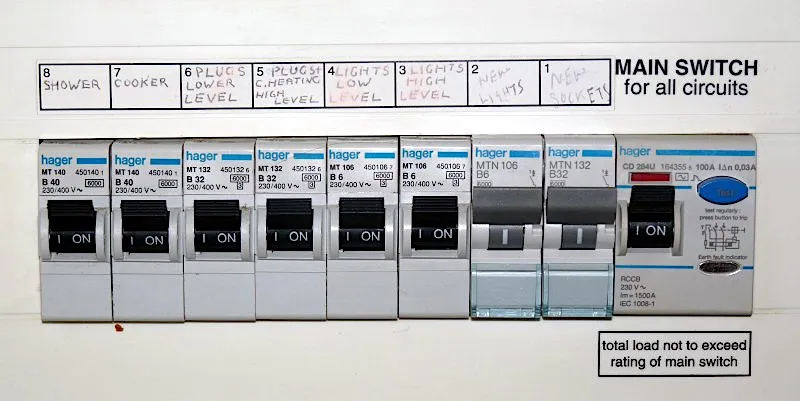
- The existing Electrical Installation Certificate or EICR, together with any previous evidence of the earthing arrangement.
- Details of any existing changeover equipment, including photographs of the intake position and consumer unit.
- Fuel storage arrangements and the proposed siting of the set.
- The maintenance and test record for any carbon monoxide alarms in the property.
Labels matter as much as paperwork. A clear notice at the intake position identifying the changeover arrangement protects both the occupier and anyone attending in an emergency, including the fire and rescue service.
Commercial Considerations
In commercial premises the stakes rise quickly. Life safety systems — fire detection, emergency lighting, alarms and any lift designated for evacuation use — require a properly designed standby supply, not an improvised one. Where a generator is intended to support business continuity, the design should distinguish clearly between life safety loads, critical loads and discretionary loads, and should be commissioned and tested under load rather than assumed to work.
The Custodian Position
Standby power is a legitimate and sensible resilience measure. It becomes a liability only when it is improvised. Our advice is consistent: decide what must stay on, have the connection designed and installed properly, site the generator outdoors with care, and keep the records that prove the arrangement is sound. Safety first, always — particularly when the alternative is a dark house and a decision made in a hurry.